- Impact Growth Capital Newsletter
- Posts
- Spirit Airlines Didn't Fail Because Conditions Changed. It Failed Because Its Model Couldn't Survive When They Did.
Spirit Airlines Didn't Fail Because Conditions Changed. It Failed Because Its Model Couldn't Survive When They Did.
The collapse of America's most recognizable ultra-low-cost carrier is not an airline story. It is a capital allocation lesson about what happens when a business is built for ideal conditions and then the world stops being ideal. Ryanair runs the same model in Europe and just posted a 42% profit increase. The difference is not the strategy. It is the structure around it.

Impact Growth Capital
May 04, 2026
For Accredited Investors & Family Offices:
We do not market deals to the public.
We Grant Access to our specific investment thesis Barbell Strategy execution via Work Force Housing and Vertical SaaaS though our:
Investor Council
We are currently reviewing applications for new members. If you are focused on capital preservation and asymmetric growth, you may apply for access here.
Hi everyone,
This week, Spirit Airlines ceased all operations and began winding down after 34 years as one of the most recognizable ultra-low-cost carriers in the United States. Its last flight, an Airbus A320 from Detroit, landed in Dallas at 1:08 a.m. on Saturday. Two hours later, the airline declared bankruptcy for the second time in less than a year and ordered the permanent cancellation of all flights worldwide. But this isn't just an airline story. It is a lesson in business model durability, and it has direct implications for how we think about capital allocation, risk, and what makes an investment resilient.
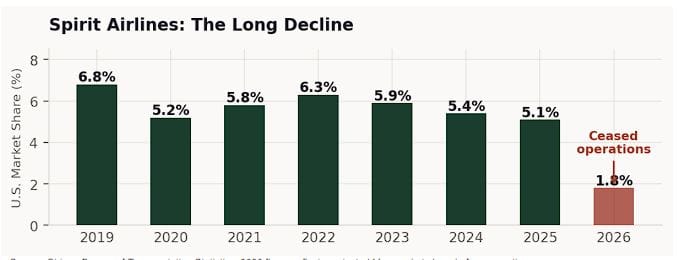
Source: Cirium, Bureau of Transportation Statistics. 2026 figure reflects projected May market share before cessation.
The Core Insight
Spirit pioneered ultra-low-cost air travel in the U.S. It stripped away every amenity, charged separately for carry-on bags, legroom, and water, and offered fares that undercut every major carrier. The model was simple: razor-thin margins, high volume, and an absolute dependence on cost advantage. For years, it worked. Spirit was consistently profitable. It forced legacy carriers to create their own basic economy fares just to compete. As one industry analyst noted, "You do not have to fly a small carrier in order to benefit from its presence, because they will bring down the big guys' fares." But the model had a structural vulnerability that only became visible under stress. Three forces converged to expose it. First, costs rose faster than Spirit could absorb them. Jet fuel prices surged more than 70% since the start of the Iran war. For an airline with margins already near zero, that kind of cost shock was existential. Spirit's CEO said there "was no alternative," pointing directly to fuel as the final trigger. Second, the competition adapted. Legacy carriers adopted Spirit's own playbook, offering basic economy fares that removed Spirit's pricing edge. When your only advantage is price, and larger competitors match it with better networks, loyalty programs, and operational scale, the moat disappears. Third, Spirit had no flexibility to pivot. The JetBlue merger that could have provided scale and strategic options was blocked in 2024. Two bankruptcy filings followed. A $500 million government bailout fell apart when creditors rejected the terms. By the end, Spirit's market share had fallen from 6.8% to 1.8%, its fleet was aging, and it had no path to profitability.
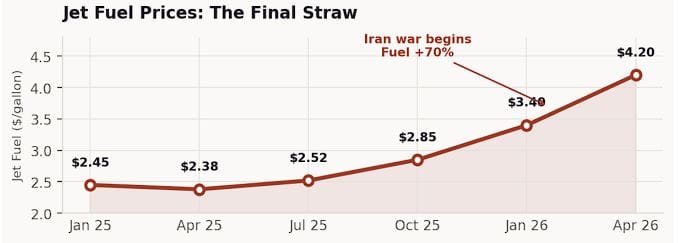
Source: EIA, Bloomberg. Jet fuel prices reflect Gulf Coast Kerosene-Type benchmark.
What This Means for Investors
Spirit's collapse is not just an airline event. It is a case study in what happens when a business model is optimized for ideal conditions and then conditions change. The lessons translate directly to how we evaluate investments across every asset class.
Business models must withstand volatility, not just benefit from stability.
Spirit was profitable when fuel was cheap, competition was limited, and demand was growing. The moment any of those conditions changed, the model broke. In capital allocation, we look for the opposite: assets and operators that perform across environments, not just favorable ones.
2. Scale and flexibility matter more than cost leadership
Being the cheapest is not a durable advantage if you lack the scale to absorb shocks or the flexibility to adapt when conditions shift. Spirit had neither. Its fleet was leased, its routes were narrow, and its financial cushion was nonexistent. The businesses that survive volatility are those with operational optionality, not just low cost structures.
3. Thin margins amplify risk during uncertainty
When your entire model depends on extracting value from the last dollar of cost advantage, any disruption becomes existential. A 70% increase in fuel costs is painful for every airline. For Spirit, it was fatal. In investing, the same principle applies: thin-margin strategies can look attractive in calm markets but become the first casualties when conditions tighten.
4. Markets reward resilience, not just growth.
Spirit grew for years. It expanded routes, added aircraft, and gained market share. But none of that growth translated into the kind of structural resilience that could withstand real adversity. Growth without durability is fragile capital. The market eventually reprices it
The Counterpoint: Why Ryanair Survives
The obvious question is: if the ultra-low-cost model is inherently fragile, why is Ryanair thriving? The answer is not that low cost is a bad strategy. It is that low cost without structural advantages is a bad strategy. The difference between Spirit and Ryanair is a masterclass in what separates fragile execution from durable positioning.
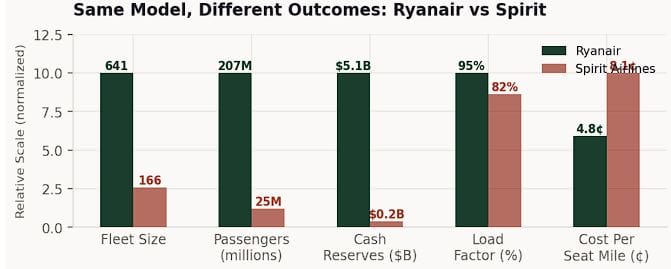
Sources: Ryanair H1 FY26 results, Spirit Q3 2025 filings, Cirium, company reports. Spirit figures reflect pre-cessation operational data.
Scale changes everything. Ryanair carries 207 million passengers annually across 641 aircraft and 2,500 routes in 36 countries. Spirit carried 25 million passengers on 166 aircraft in a single domestic market. That scale difference is not just a size advantage. It is a cost structure advantage. Ryanair's cost per available seat mile is roughly 4.8 cents. Spirit's was over 8 cents. When both models face the same fuel shock, one has room to absorb it. The other does not.
Financial discipline creates optionality. Ryanair sits on approximately $5.1 billion in cash reserves and generated $2.9 billion in profit in the first half of its fiscal year 2026, a 42% increase over the prior year. Its shareholders' equity stands at $8.8 billion. Spirit entered its second bankruptcy with negligible cash, seeking a $500 million government bailout just to remain operational. When stress hits, cash is not just a buffer. It is the difference between choosing your response and having no choice at all.
Fleet economics compound over time. Ryanair operates 204 Boeing 737 MAX 8-200 aircraft that carry 197 passengers each, seat 4% more passengers than standard models, and burn 16% less fuel. It owns its aircraft and is retrofitting winglets across its fleet to reduce fuel consumption by another 1.5%. Spirit leased 166 aircraft at an average monthly rent of $326,000 per plane with no ownership equity. Ryanair's fleet is a compounding asset. Spirit's was a compounding liability.
Competitive positioning protects pricing power. Ryanair dominates European short-haul travel with a 95% load factor and faces constrained competition because European capacity is expected to remain limited through 2030 due to manufacturer delays and consolidation. Spirit operated in the most competitive aviation market in the world, where legacy carriers adopted its own pricing playbook and eliminated its only differentiation.
Should We Expect the Same Outcome for Ryanair?
Not in the near term, and probably not at all under current conditions. Ryanair's financial position is fundamentally different from where Spirit stood at any point in its decline. But the lesson still applies forward: the model is only as strong as the structural advantages surrounding it. The risks that could eventually pressure Ryanair are real but different in nature. A sustained European recession could compress fares. Regulatory changes around carbon taxation are increasing environmental compliance costs. Boeing delivery delays have constrained growth in the past. And if European market consolidation eventually produces a competitor with comparable scale and cost discipline, the pricing moat could narrow.
The critical difference is that Ryanair has the financial strength to absorb these shocks while adapting. It has $5 billion in cash, no net debt after repaying its last remaining bond in May 2026, and a fleet orderbook of 300 MAX-10 aircraft extending through 2034. That is the difference between a business model that depends on conditions staying favorable and one that has built the resilience to survive when they do not.
What We're Doing at Impact Growth Capital
Spirit's story reinforces why we build the way we build. Every investment in our portfolio is evaluated through one question: does this work when conditions are not perfect? Workforce housing demand does not depend on fuel prices, consumer discretionary spending, or competitive pricing dynamics. It is driven by demographics: people need housing regardless of what is happening in the broader economy. Rents are renewal driven. Occupancy is structural. The income stream does not require perfect conditions to function. We maintain conservative leverage specifically because environments like this one, where external shocks destroy overleveraged operators, create the best acquisition opportunities for those with capital and discipline.
Our thesis is simple. We do not invest in models that require ideal conditions. We invest in assets where demand is essential, cash flow is observable, and the downside is protected by structural necessity rather than market sentiment.
What This Means Going Forward
Spirit will not be the last fragile business model to fail in this environment. The Iran war has pushed fuel costs to levels that stress every cost-sensitive operator. Rising interest rates have tightened financing for leveraged companies. Consumer spending patterns are shifting in ways that punish businesses without pricing power. Consolidation will continue. Spirit's 17,000 employees are looking for work. Its routes are being absorbed by larger carriers. Its aircraft, averaging just 5.5 years old, will be redistributed. Capital that was trapped in a failing model will be redeployed. For disciplined allocators, that redeployment creates opportunities in assets that were not available or were overpriced twelve months ago.
The broader signal is clear. Capital is moving toward resilience and away from fragility. Toward assets with margin buffers, durable demand, and the operational flexibility to survive when conditions change. That is the shift, and it is accelerating.
The Bottom Line
Spirit Airlines did not fail because conditions changed. Every business faces changing conditions. Spirit failed because it could not survive when they did.
That distinction is the entire lesson. In capital allocation, the question is never whether conditions will change. They always do. The question is whether the assets you own, the operators you back, and the models you invest in can absorb the change and keep generating income on the other side
At Impact Growth Capital, every investment decision starts there.
If you're allocating capital in this environment, understanding where capital is moving matters more than where it has been.
If you're evaluating how to position capital for durability in this environment, we're happy to walk through it with you.
We'll give you personalized guidance on the best funding opportunities for your mission.