- Impact Growth Capital Newsletter
- Posts
- Impact Growth Capital Newsletter
Impact Growth Capital Newsletter
Stagflation Risk Returns. Private Credit Cracks. The Barbell Holds.

Impact Growth Capital
March 09, 2026
For Accredited Investors & Family Offices:
We do not market deals to the public.
We Grant Access to our specific investment thesis Barbell Strategy execution via Work Force Housing and Vertical SaaaS though our:
Investor Council
We are currently reviewing applications for new members. If you are focused on capital preservation and asymmetric growth, you may apply for access here.
This week at IGC:
February's jobs print landed well outside consensus. BlackRock's credit fund hit its redemption cap. Two signals pointing in the same direction: capital is repricing for a bumpier environment.
Stagflation Risk Returns
February's jobs report landed well outside consensus. The economy shed 92,000 nonfarm payrolls against expectations of 50,000 new hires — one of the sharpest single-month contractions since the pandemic era. Unemployment edged up to 4.4%, with approximately 7.6 million Americans now out of work.
-92,000 February Payrolls | 4.4% Unemployment Rate | +3.8% Wage Growth YoY |
The Headline Isn't Even the Worst Part
Revisions Reveal a Weaker Foundation Than Reported
December, originally reported as a gain of 48,000 jobs, was revised down to a loss of 17,000. Combined with a downward revision to January, the economy entered February already 69,000 jobs lighter than previously reported. On a three-month rolling basis, average job growth is now under 6,000 per month.
The Dilemma
Jobs Contracting. Prices Rising. The Fed Has No Clean Options.
Average hourly earnings rose 0.4% in February and are up 3.8% year over year — both above forecast. Oil prices continue to climb, driven by the ongoing Iran conflict. This is the textbook setup for stagflation: a contracting economy paired with persistent price pressure. Tightening deepens the slowdown. Easing risks entrenching inflation. The Fed's current posture: wait and see.
This Week's Defining Data Point
CPI Release — Wednesday, March 11, 8:30 a.m. ET
January's reading showed CPI up 2.4% year over year. The question is whether February continues that trend or accelerates it. Incoming housing data and supplemental labor figures round out a calendar that should produce continued market volatility.
BlackRock's Liquidity Moment
BlackRock's $26 billion HPS Corporate Lending Fund a non-traded BDC that deploys capital directly to mid-sized corporate borrowers outside traditional bank channels hit its pre-structured quarterly redemption cap for the first time in the fund's history.
$1.2B Redemptions Requested (9.3% of NAV) | $620M Redemptions Honored (5% Cap) | -8.3% BLK Share Decline |
Important context: the 5% cap is a pre-structured feature built into the fund's governing documents. It is not a reactive decision made under pressure. Gates exist in private credit to prevent liquidity mismatches from forcing premature asset liquidation that would harm all investors. BlackRock framed it as a foundational feature that protects the fund from becoming a forced seller of assets.
Firm | Redemptions Requested | Response |
|---|---|---|
BlackRock $26B HPS Corporate Lending Fund | $1.2B (9.3% of NAV) | Honored 5% cap per governing docs. $620M paid. |
Blackstone $82B Private Credit Vehicle | $3.8B in Q1 | Raised limit from 5% to 7%. Injected $400M of firm + employee capital. Met all requests. |
The Broader Signal
This Is Not an Isolated Event
Sentiment across the $1.8 trillion private credit industry has been deteriorating for months. High-profile borrower defaults in late 2025, concerns about AI-driven disruption to software company borrowers, and now visible redemption pressure across multiple marquee managers signal a sector-wide repricing of liquidity risk. Two firms, same pressure, different responses but the underlying stress is the same.
Two Signals. One Direction. The Premium on Durable Assets Is Increasing.
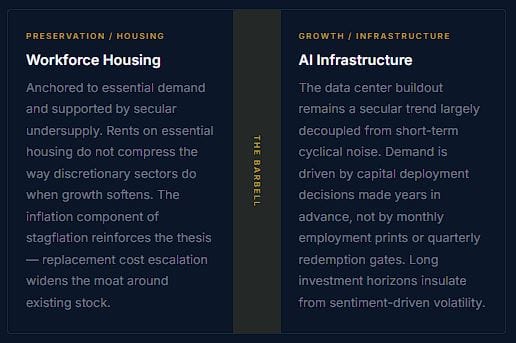
The stagflation setup and the private credit liquidity event point in the same direction: capital is pricing in a bumpier macro environment, and the premium on structurally defensive, yield-producing assets is increasing.
Bottom Line
When liquid markets gate and jobs data contracts, the assets that hold are the ones tied to structural demand not cyclical sentiment.
The February jobs print and BlackRock's redemption event are not separate stories. They are two expressions of the same macro reality: the easy-money cycle is over, liquidity risk is being repriced, and the margin of safety in private markets is narrowing except where demand is structural and capital structures are built for duration. Workforce housing doesn't need rate cuts to fill units. AI infrastructure doesn't need employment growth to sign capacity contracts. That's not a thesis statement. That's what the data is confirming in real time.
Jesse Sells
Founder | Impact Growth Capital
Have a topic or question you want to see covered? Reply directly to this email.
